
This is Lesson 1 of 8 from AI For Youth: Grade 1, shown exactly as subscribers see it. No account is needed to read it. Subscribers get every lesson, the graded quizzes, the project, progress tracking, and a certificate of completion.
Get accessYour child already lives in a world full of AI, and that will be true for the rest of their life. The good news is that understanding it is well within reach. This course explains how AI really works at your child’s grade level, one clear lesson at a time, so they can use it with confidence and know when to double-check it. The first lesson is below. Read it together and see if it fits.
This lesson is about asking a question to find something out. To find out which fruit your class likes best, you ask every child the same question, in the same words. Then you give each answer one dot on your paper.
For parents/guardians
- You need: paper and a pencil. Later, some people to ask.
- How long: ten minutes reading.
- Listen for: them wanting to add “…or do you like bananas?” to help somebody along. That is prompt 2.
By the end of this lesson you can
- Say why you use the same words for every person.
- Say what is wrong with “you like apples, don’t you?”
- Say why the question goes on the paper before you start.
- Read the dots and say which fruit got the most.
Say the same words
A question is the words you say to find something out. In this lesson the question is: “What fruit do you like best?”
You want to know which fruit your class likes best. So you ask them.
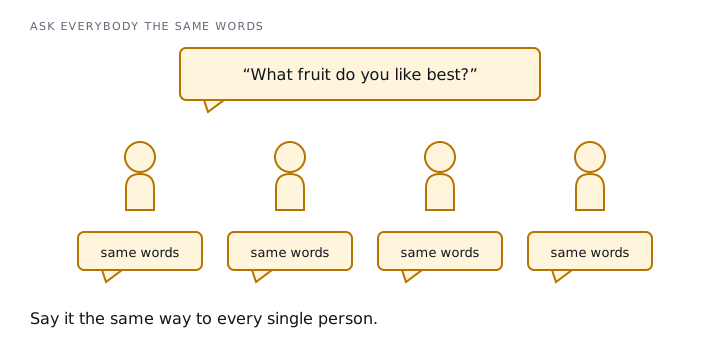
Look at the picture. One speech bubble says the question. Four children hear it. Every child hears the same words.
Pick your words. Then do not change them.
Say it the same way to every single person. Then everybody is answering the same question.
Do not help them answer
There is a wrong way to ask. Look at the picture.
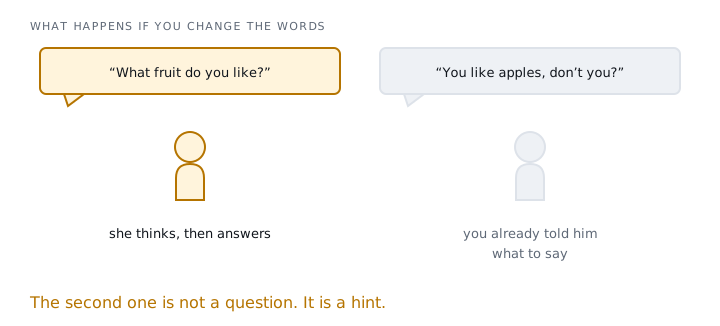
On the left, you say “What fruit do you like?” The child thinks. Then the child answers.
On the right, you say “You like apples, don’t you?” The child does not need to think. You have already told the child what to say.
The second one is not a question. It is a hint.
If you say “you like apples, don’t you?” most people will say yes to be nice.
Then you have not found out what they like. You have found out what you said.
A question lets the person think. A hint tells the person what to say.
Write it on the paper
It is easy to forget your words. Even grown-ups forget. They start one way, and halfway through they say it differently.
So write your question on the paper before you start.
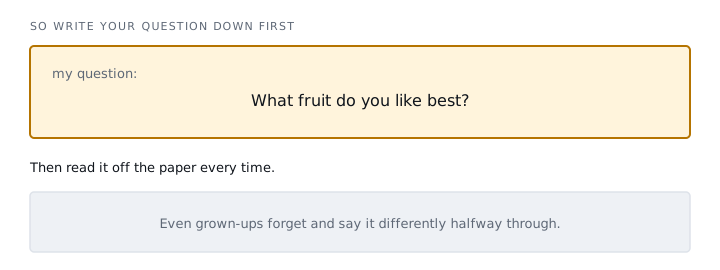
Look at the picture. The paper says: My question. What fruit do you like best?
Then read it off the paper each time. That way you cannot forget. The words stay the same for everybody.
- Write your question on the paper.
- Go to the first person. Read the question off the paper.
- Go to the next person. Read it again, the same way.
- Keep going until you have asked everybody.
Reading the dots
Ten children answered. Each child gets one dot. The dot goes next to the fruit that child said.
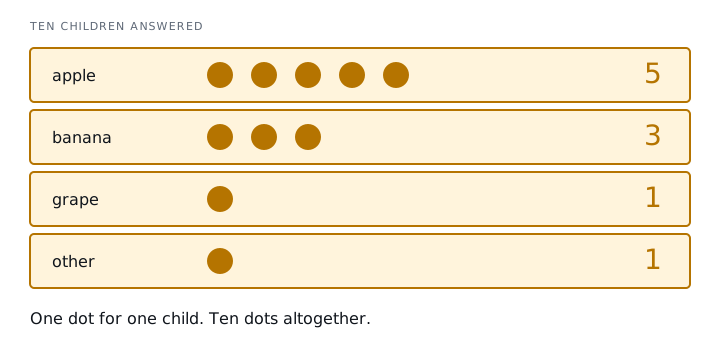
Look at the picture. Apple has 5 dots. Banana has 3 dots. Grape has 1 dot. Other has 1 dot.
One dot is one child. Count all the dots: 5 and 3 and 1 and 1. That is ten dots. Ten children, ten dots.
Apple has the most dots. Five children like apples best.
Try it
- With your grown-up, write a question on a piece of paper. You can use “What fruit do you like best?” Read it out loud.
- Ask three people in your home. Read the words off the paper each time.
- Draw one dot for each person, next to the answer they gave. Count the dots.
Answers
1. Any short question about something harmless is fine. Listen for the child reading the same words every time.
2. If the child adds “…or do you like bananas?” or says “you like apples, don’t you?”, that is a hint, not a question. Ask them to read it from the paper again.
3. Three people, three dots. If there are more or fewer dots than people, one person got two dots or one person was missed. Lesson 2 is about that check.
Lesson 2 is about making sure everybody answers once, and only once.
Summary
- To find out which fruit the class likes best, you ask every child the same question.
- Say the same words to every person. Then everybody is answering the same question.
- “You like apples, don’t you?” is a hint, not a question. It tells the person what to say, so you only find out what you said.
- Write the question on the paper first. Read it off the paper each time, so you cannot forget.
- One dot for one child. Apple 5, banana 3, grape 1, other 1. Ten children, ten dots. Five children like apples best.
Key terms
- Question — the words you say to find something out; the same words for every person.
- Hint — words that tell the person what to say, such as “you like apples, don’t you?”
- Dot — one mark on the paper for one child’s answer.
Check your understanding
5 questions · 70% to pass · retakes encouraged
In the full course the graded quiz comes next and your progress is saved. Get access to continue.
Want the next free lesson by email? We post new free lessons and short tips for guiding your child with AI.
A short note when new free lessons are posted, plus occasional tips. No spam. Unsubscribe any time.That is the whole first lesson. The full AI For Youth: Grade 1 course has 8 lessons, 8 quizzes, and a project. One subscription unlocks every course, kindergarten through grade 12, plus AI Fundamentals for general audiences.
Get access