
This is Lesson 1 of 8 from AI For Youth: Grade 2, shown exactly as subscribers see it. No account is needed to read it. Subscribers get every lesson, the graded quizzes, the project, progress tracking, and a certificate of completion.
Get accessYour child already lives in a world full of AI, and that will be true for the rest of their life. The good news is that understanding it is well within reach. This course explains how AI really works at your child’s grade level, one clear lesson at a time, so they can use it with confidence and know when to double-check it. The first lesson is below. Read it together and see if it fits.
This lesson is about writing down what you count. Counting in your head is easy to get wrong, and easy to forget. One mark on paper for each thing keeps the number safe. Bundles of five make the marks quick to read.
For parents/guardians
- You need: a pile of about a dozen small things, paper and a pencil.
- How long: ten minutes reading, ten minutes doing.
- Listen for: them noticing that they lost their place. That is the whole lesson, so let it happen rather than helping.
By the end of this lesson you can
- Make one mark for each thing you count.
- Put the marks in bundles of five.
- Say why the paper remembers a number better than your head does.
Counting the socks
Data is what you find out when you count or when you ask. Recording data means writing it down, so the paper remembers it for you.
Look at the picture. There is a pile of socks. Count them.
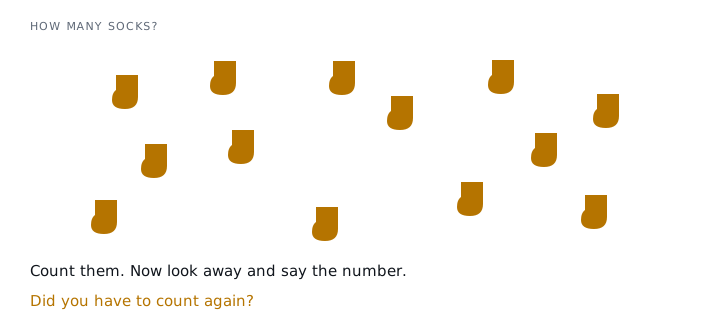
There are thirteen socks.
Now cover the page. Say the number again. That is easy, because you only just counted.
An hour later, somebody asks again. The number is gone. You have to count all over again.
Counting goes wrong
Two children counted the same pile of socks.
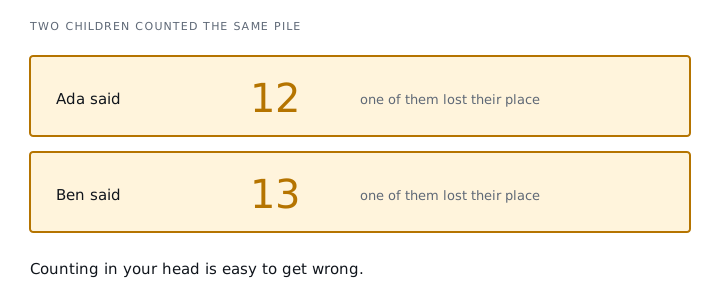
Ada said 12. Ben said 13. They counted the same socks.
One of them counted a sock twice, or missed one out. That is how counting in your head goes wrong. You lose your place.
This happens to everybody. It is not about being clever.
One mark for each sock
Instead of holding the number in your head, make a mark on paper.
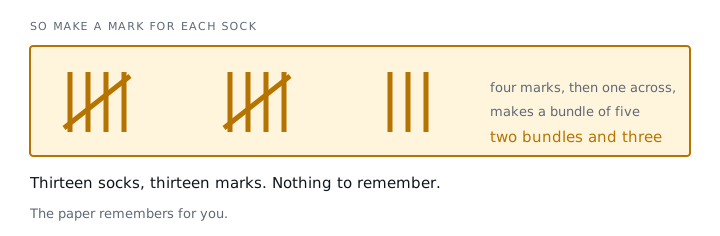
- Pick up a sock. Make one mark.
- Pick up the next sock. Make one more mark.
- Keep going until the pile is gone.
Thirteen socks make thirteen marks. You are not holding a number in your head at all. The paper is doing it for you.
If somebody asks an hour later, you look at the paper. You do not count the socks again.
Bundles of five
A bundle is five marks together. Four marks stand up. The fifth mark lies across them.
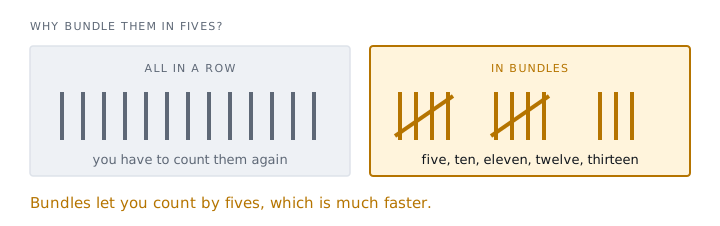
Thirteen marks in a row are hard to read. You have to count them all again.
In bundles, you count by fives. Two bundles and three more marks. You say five, ten, then eleven, twelve, thirteen.
Both sides of the picture show thirteen marks. The bundles are much quicker to read, because you can count the bundles by fives.
Try it
- Put about a dozen small things in a pile. Count them in your head. Say the number.
- Count them again. This time make one mark on paper for each thing. Put the marks in bundles of five.
- Cover the pile. Later on, say how many things there were without counting them again.
Answers
1. Any number. If the child loses their place, let it happen. That is the lesson.
2. The number of marks should be the same as the number of things. Each bundle is four marks standing up and one laid across them.
3. The child reads the paper instead of counting the pile again. Count the bundles by fives, then the extra marks one at a time.
Lesson 2 turns the marks into something you can see from across the room.
Summary
- Counting in your head is easy to get wrong. Ada said 12 and Ben said 13 for the same thirteen socks.
- Make one mark for each thing. Then the paper remembers the number, not you.
- Five marks make a bundle: four standing up, one across them.
- Bundles let you count by fives, so they are quicker to read than marks in a row.
Key terms
- Data — what you find out when you count or when you ask.
- Record — write the data down, so the paper remembers it.
- Bundle — five marks: four standing up and one across them.
Check your understanding
5 questions · 70% to pass · retakes encouraged
In the full course the graded quiz comes next and your progress is saved. Get access to continue.
Want the next free lesson by email? We post new free lessons and short tips for guiding your child with AI.
A short note when new free lessons are posted, plus occasional tips. No spam. Unsubscribe any time.That is the whole first lesson. The full AI For Youth: Grade 2 course has 8 lessons, 8 quizzes, and a project. One subscription unlocks every course, kindergarten through grade 12, plus AI Fundamentals for general audiences.
Get access