
This is Lesson 1 of 8 from AI For Youth: Grade 4, shown exactly as subscribers see it. No account is needed to read it. Subscribers get every lesson, the graded quizzes, the project, progress tracking, and a certificate of completion.
Get accessYour child already lives in a world full of AI, and that will be true for the rest of their life. The good news is that understanding it is well within reach. This course explains how AI really works at your child’s grade level, one clear lesson at a time, so they can use it with confidence and know when to double-check it. The first lesson is below. Read it together and see if it fits.
This lesson is about grouping. You will learn what a group really is, why the same objects can be grouped in more than one way, and the one rule that makes grouping work: ask one question at a time.
By the end of this lesson you can
- Sort a pile of objects into groups.
- Group the same objects in more than one way.
- Say why you can only ask one question at a time.
One set of buttons, three groupings
Grouping means putting objects into piles so that the objects in each pile have something in common.
Here are six buttons, numbered 1 to 6. The instruction is: put them into two groups. There is more than one correct way to do it. Figure 1 shows three.
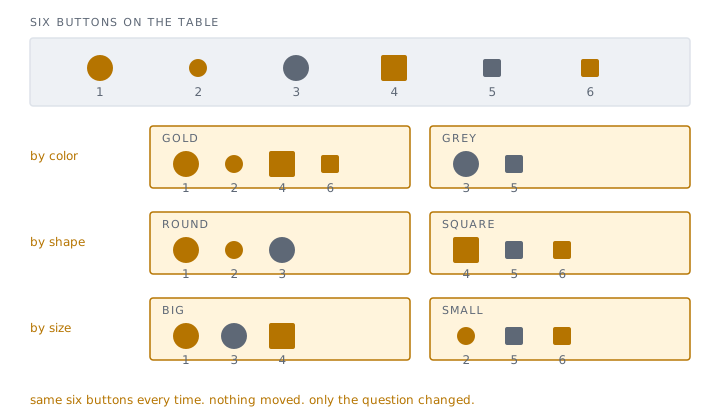
Worked example. Read the three groupings from Figure 1.
by shape round: 1, 2, 3 square: 4, 5, 6
by size big: 1, 3, 4 small: 2, 5, 6
All three groupings are correct. The buttons did not change and nothing moved. The only thing that changed was the question asked about them: what color, what shape, or what size.
A group is the answer to a question
A group (or pile) is not just “things that go together.” A group is the answer to a question.
Ask “what color is it?” and the answer is two groups, gold and grey. Ask “what shape is it?” and the answer is two different groups, round and square. Same buttons, different question, different groups.
Before you group anything, decide what question you are asking.
This matters because people often argue about groups without noticing that they are answering different questions. One person is grouping by color and the other by shape. Neither is wrong. They just did not agree on the question first.
Try it
- Using Figure 1, which buttons are gold?
- Button 5 is in the grey group, the square group and the small group. Did button 5 move between the three groupings?
- Give a fourth question you could ask about a pile of buttons.
Answers
1. 1, 2, 4 and 6.
2. No. Nothing moved. Button 5 is grey, square and small all at once. Each grouping asked a different question about it.
3. Any question with a clear answer, for example “how many holes does it have?” or “is it shiny or dull?”
What goes wrong with two questions
Now consider this instruction: put the gold ones in one box and the round ones in the other.
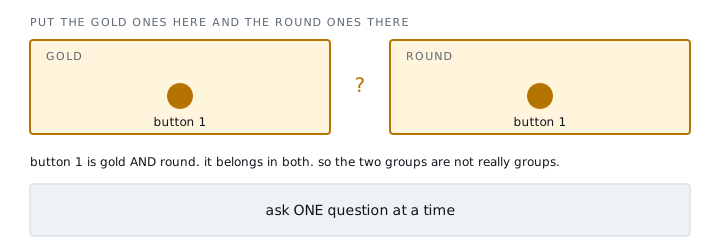
This instruction cannot be followed. Button 1 is gold and it is round, so it belongs in both boxes at once. A thing that goes in both boxes is not sorted at all.
The instruction sounded sensible, but it was broken. It asked two questions at the same time: “what color?” and “what shape?” One box answered the first question and the other box answered the second. Button 1 answered both.
Try it
- Which other button from Figure 1 is both gold and round?
- Somebody says: “put the big ones in one box and the square ones in the other.” Find a button that belongs in both boxes.
Answers
1. Button 2. It is in the gold group (1, 2, 4, 6) and in the round group (1, 2, 3).
2. Button 4. It is big (1, 3, 4) and square (4, 5, 6). The instruction asks two questions at once, so it fails just like the gold-and-round one.
The rule, and where it is used
The rule for grouping has three parts.
every thing lands in exactly one group
nothing is left over
The second and third parts follow from the first. If you ask one question, every object has one answer, so it lands in exactly one group, and no object is left without a group.
This rule is used all around you. A supermarket puts every item in one aisle. A library gives every book one shelf. A school puts every pupil in one class.
None of these is the only possible grouping. A supermarket could arrange food by country instead of by type, and some do. The grouping a supermarket chose is not the only correct one. It picked one question and stuck to it.
Lesson 2 asks for something harder. Groups have no order: gold is not before grey. Sometimes you want things in a line, first to last, and that needs something extra, called a measure.
Summary
- Grouping means putting objects into piles. The same six buttons can be grouped by color (gold: 1, 2, 4, 6; grey: 3, 5), by shape (round: 1, 2, 3; square: 4, 5, 6) or by size (big: 1, 3, 4; small: 2, 5, 6). All three are correct, because only the question changed.
- A group is the answer to a question. Decide the question before you group.
- Asking two questions at once breaks grouping. “Gold in one box, round in the other” fails because button 1 is both.
- The rule: one question at a time, every thing lands in exactly one group, nothing is left over.
- A supermarket, a library and a school each chose one question. Other questions would also work.
Key terms
- Grouping — putting objects into piles so the objects in each pile have something in common.
- Group — the answer to a question asked about the objects.
Check your understanding
5 questions · 70% to pass · retakes encouraged
In the full course the graded quiz comes next and your progress is saved. Get access to continue.
Want the next free lesson by email? We post new free lessons and short tips for guiding your child with AI.
A short note when new free lessons are posted, plus occasional tips. No spam. Unsubscribe any time.That is the whole first lesson. The full AI For Youth: Grade 4 course has 8 lessons, 8 quizzes, and a project. One subscription unlocks every course, kindergarten through grade 12, plus AI Fundamentals for general audiences.
Get access