
This is Lesson 1 of 8 from AI For Youth: Grade 5, shown exactly as subscribers see it. No account is needed to read it. Subscribers get every lesson, the graded quizzes, the project, progress tracking, and a certificate of completion.
Get accessYour child already lives in a world full of AI, and that will be true for the rest of their life. The good news is that understanding it is well within reach. This course explains how AI really works at your child’s grade level, one clear lesson at a time, so they can use it with confidence and know when to double-check it. The first lesson is below. Read it together and see if it fits.
This lesson introduces the order of steps in a plan. It explains why the same steps in a different order give a different result, how to spot a step that has to wait for another one, and how to find the right order by asking one question about each step.
By the end of this lesson you can
- Explain why the same steps in a different order give a different result.
- Spot a step that has to wait for another one.
- Draw a job as a chain of steps.
Two steps, two orders
A plan is a list of steps for doing a job. The order of a plan is which step comes first, which comes second, and so on.
Here is a job with only two steps in it: socks on, shoes on. There are two possible orders for these two steps.
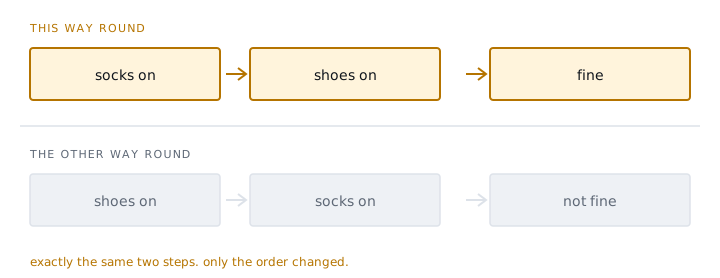
Socks on, then shoes on, works. Shoes on, then socks on, does not work. Nothing else changed. Same socks, same shoes, same feet. The only difference between the two plans is the order.
With shoes and socks you notice the problem right away. In many jobs the wrong order does not show until much later. That is why order is the first thing to learn about plans.
Try it
- Here are two steps: open the jar and take out a cookie. Write both orders. Which one works?
Answer
Order A: open the jar, then take out a cookie. Order B: take out a cookie, then open the jar. Only Order A works. You cannot take a cookie out of a jar that is still closed. The steps are the same; only the order is different.
Steps that have to wait
A step waits for another step when it cannot start until that other step has finished.
Making a pancake has four steps. Each one waits for the one before it.
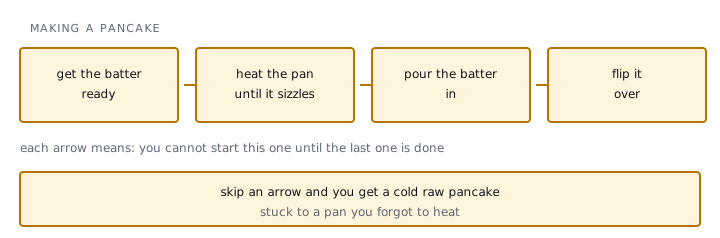
Look at the third arrow. You cannot pour the batter in until the pan is hot. This is not a rule that somebody made up. It is true because of how pans and batter actually work. Cold batter in a cold pan does not cook. It sticks.
A chain is a row of steps where each step waits for the one before it.
Chains are the easy kind of plan, because there is only one possible order. The pancake plan is a chain: batter, then pan, then pour, then flip. No other order works.
Finding the order
When you have a job to plan, one question finds the chain for you. Ask it about every step.
What has to be true before I can start this step?
- Write down every step in the job.
- For each step, ask: what has to be true before I can start this step?
- Every answer names a step that must come earlier. Put those steps first.
- Draw an arrow from each earlier step to the step that waits for it.
Worked example. Ask the question about two of the pancake steps.
what has to be true first? the pan is hot, and the batter exists
so two steps come before it
flip it over
what has to be true first? there is a pancake in the pan
so pouring comes before it
Ask the question about every step and the order sorts itself out. You are not guessing. You are reading the order off the job itself.
Try it
- The job is to mail a letter. The steps are: put a stamp on it, write the letter, put it in the mailbox, put it in the envelope. Ask the question about each step and write the steps as a chain.
Answer
Write the letter, then put it in the envelope, then put a stamp on it, then put it in the mailbox. “Put it in the envelope” needs a written letter first. “Put a stamp on it” needs the envelope to be ready. “Put it in the mailbox” needs the stamp on. Four steps, one chain.
Why order matters so much
Getting the order wrong is one of the most common ways a plan fails. It almost never looks like a mistake while you are making it.
Think about packing a bag for a trip. Suppose you put your shoes in first and your shirts on top. Nothing is broken. But the shirts come out creased. Every step was right, and the order still cost you something.
Computers run into this problem constantly. That is why it is the first thing in this course. A computer does its steps in exactly the order you give them. It has no idea what any of the steps are for. So if you put the steps in the wrong order, the computer will do the wrong thing without noticing anything is wrong.
Lesson 2 asks the opposite question. Some steps have to wait, but many do not. Spotting the steps that do not have to wait is how you stop wasting time.
Summary
- A plan is a list of steps. The same steps in a different order can give a different result. Socks then shoes works; shoes then socks does not.
- A step waits for another step when it cannot start until that step is finished. You cannot pour batter into a pan until the pan is hot, because of how pans and batter actually work.
- A chain is a row of steps where each one waits for the one before it. A chain has only one possible order.
- To find the order, ask about every step: what has to be true before I can start this step?
- A computer does steps in the order you give them, with no idea what they are for. The wrong order gives the wrong result.
Key terms
- Plan — a list of steps for doing a job.
- Order — which step comes first, second, and so on.
- Waits — a step waits for another when it cannot start until that one is finished.
- Chain — a row of steps where each one waits for the one before it.
Check your understanding
5 questions · 70% to pass · retakes encouraged
In the full course the graded quiz comes next and your progress is saved. Get access to continue.
Want the next free lesson by email? We post new free lessons and short tips for guiding your child with AI.
A short note when new free lessons are posted, plus occasional tips. No spam. Unsubscribe any time.That is the whole first lesson. The full AI For Youth: Grade 5 course has 8 lessons, 8 quizzes, and a project. One subscription unlocks every course, kindergarten through grade 12, plus AI Fundamentals for general audiences.
Get access