
This is Lesson 1 of 8 from AI For Youth: Grade 7, shown exactly as subscribers see it. No account is needed to read it. Subscribers get every lesson, the graded quizzes, the project, progress tracking, and a certificate of completion.
Get accessYour child already lives in a world full of AI, and that will be true for the rest of their life. The good news is that understanding it is well within reach. This course explains how AI really works at your child’s grade level, one clear lesson at a time, so they can use it with confidence and know when to double-check it. The first lesson is below. Read it together and see if it fits.
This lesson covers the gap between what an instruction says and what the person who wrote it meant. It shows how one ordinary instruction can be obeyed in several wrong ways, explains why a machine that takes every word at face value is more useful than a helpful one, and gives three questions that pin an instruction down so it can only be followed one way.
By the end of this lesson you can
- Show how one instruction can be obeyed in several wrong ways.
- Explain the difference between what you said and what you meant.
- Say why being completely literal is useful rather than annoying.
- Pin down an instruction so there is only one way to follow it.
Said and meant
An instruction is a sentence that tells someone what to do. Most instructions work because the reader already understands the point of the job and quietly fills in whatever is missing. This lesson looks at what happens when the reader does not do that.
A literal follower is a reader who does exactly what the words say, adds nothing, and never guesses what the words were for.
Take the job of making a jam sandwich, written as instructions for a literal follower who has never seen a sandwich and does not know what one is for. The first instruction most people write is put the jam on the bread. Figure 1 shows three ways of obeying it.
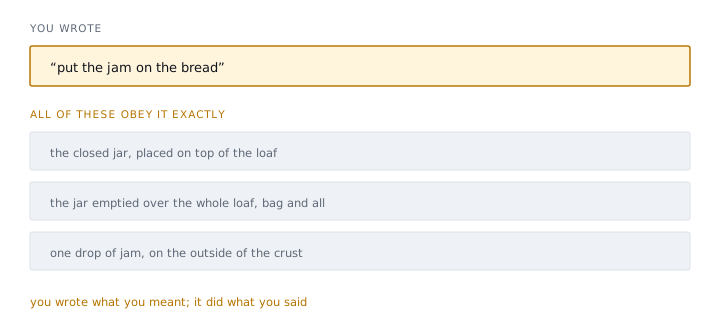
The first follower places the closed jar on top of the loaf. The second empties the jar over the whole loaf, bag and all. The third puts one drop of jam on the outside of the crust. Every one of these is a correct reading of the words. The jar is jam. The loaf is bread. Placing one on the other is putting it on. If you objected, each follower could truthfully reply “that is what you asked for”, and none of them has disobeyed you.
This gap is the subject of the whole course. You wrote down what you meant. The follower did what you said. Those are two different things, and almost every mistake in computing lives in the distance between them.
Try it
- Someone follows put the jam on the bread by placing the closed jar on top of the loaf. Have they disobeyed the instruction? Explain.
- Give one more reading of put the jam on the bread that obeys the words and still does not make a sandwich.
Answers
1. No. They did exactly what the words say. The instruction described what you meant badly, but it was followed correctly.
2. Any reading that fits the words will do, for example spreading jam on the whole uncut loaf, or putting the jar inside the bread bag.
Why a literal machine is the useful kind
When someone says a computer does exactly what it is told, the word “exactly” is not an exaggeration. Nothing inside the machine does the job a person does automatically when reading instructions.
A person reading your instructions runs a second process alongside the reading. They ask themselves what the instructions are for. They work out that you want a sandwich, and from then on they interpret every line in the light of that goal. If you forget to mention a knife, they fetch one. A machine has no such second process. If no knife is mentioned, there is no knife.
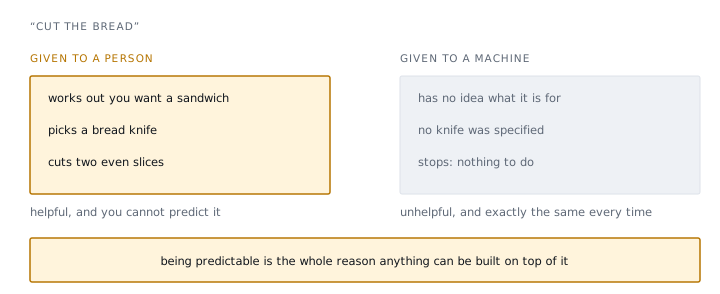
Figure 2 shows the instruction cut the bread given to both kinds of reader. The person picks a bread knife and cuts two even slices. That is helpful, and it is also unpredictable, because a different person would make a different choice. The machine finds no knife specified and stops with nothing to do. That is unhelpful, and it is exactly the same every time.
The literal column is the one we want. Consider what is lost with a helpful interpreter. If your instructions are filled in using somebody’s judgment, then their judgment becomes part of the result. The next person’s judgment will be slightly different, and so will the result. You could never be sure what your instructions actually do.
Predictability is the property that the same instructions always produce the same result. A machine that does precisely what it is told, every time, with no opinions of its own, has this property.
Predictability sounds dull, and it is the reason enormous things can be built out of small reliable pieces. Each piece can be trusted to do the same thing every time, so pieces can be stacked without the lower ones shifting. Literalness is not a limitation to work around. It is the foundation.
Try it
- A person reading your instructions does something a machine cannot. What is it?
- A friend says a machine being completely literal is a nuisance that programmers have to work around. Give the reason it is a good thing instead.
Answers
1. They work out what the instructions are for and fill in anything you forgot.
2. The same instructions always produce the same result, so you can know what your instructions actually do and build larger things out of reliable pieces.
Pinning an instruction down
An instruction is pinned down when there is only one way to follow it. Three questions catch most of the gaps that let in extra readings.
in what order? what has to have happened first
when do I stop? how do I know this step is finished
Worked example. Apply the three questions to an instruction that sounds simple: put the socks into pairs.
- Which one exactly? Which socks: all of them, or only the ones in this basket?
- In what order? Paired by what: color, size, or both?
- When do I stop? When the basket is empty, or when there are no unmatched socks left? These are different, because there may be a sock with no partner.
The third question is the one people most often forget, and it causes the worst trouble. An instruction with no clear stopping point can be followed forever, and a machine will do exactly that.
A pinned-down version reads: take socks one at a time from this basket. For each one, look through the socks already on the table for a matching one. If you find a match, put the pair in the drawer. If not, leave the sock on the table. Stop when the basket is empty.
This version is longer and duller, and there is only one way to follow it. Notice that it also handles the odd sock without being told to, because the stopping rule is about the basket rather than about pairs.
Try it
- Of the three questions that pin an instruction down, which one do people most often forget, and what goes wrong when it is left out?
- Apply the three questions to water the plants. Write one gap for each question.
Answers
1. “When do I stop?” Without a stopping point the instruction can be followed forever.
2. Example gaps: which plants (all of them, or only the ones indoors); in what order (fill the can before pouring); when to stop (when the soil is damp, or when the can is empty). Any reasonable gap for each question is acceptable.
Why this skill matters
There are two reasons to practice writing instructions for a literal follower, even though almost nobody writes sock instructions for a machine.
The first reason is practical. This is what programming is, underneath every language and tool. Being able to say precisely what should happen, in what order, until when, is the skill. Everything else is notation.
The second reason is where this course is heading. Writing a task down as instructions is the hardest test of whether you really understand it. It is possible to be fluent at something and still be unable to say how you do it. Pairing socks felt obvious until it was written down, and then three decisions appeared that nobody had noticed making.
If you cannot write it down, you do not know how you do it — you just know that you can.
For socks, this is a small surprise, and a little care fixes it. For some other tasks the gap turns out to be permanent, and no amount of care will close it. The second half of this course is about those tasks.
The ordinary skills come first. Lesson 2 takes a job far too big to write in one go and breaks it into pieces small enough to be followed.
Try it
- Pairing socks felt obvious until you tried to write it down. What does that show about the difference between doing something and knowing how you do it?
Answer
Being able to do something is not the same as knowing how you do it. Writing the task down is the test, and the sock example shows that fluent doing can hide decisions you never noticed.
Summary
- One instruction can be obeyed in several wrong ways. Put the jam on the bread fits the jar on the loaf, jam over the whole loaf, and one drop on the crust. None of these disobeys the words.
- What you said and what you meant are different things. A literal follower does what you said.
- A person works out what instructions are for and fills in gaps. A machine does not, so its result is unhelpful but exactly the same every time.
- Literalness is the useful property, because the same instructions always produce the same result, and reliable pieces can be built into large things.
- Three questions pin an instruction down: which one exactly, in what order, and when do I stop. The last is the one people forget, and without it an instruction can be followed forever.
- Writing a task as instructions is the hardest test of understanding it. If you cannot write it down, you only know that you can do it, not how.
Key terms
- Literal follower — a reader who does exactly what the words say and never guesses what they were for.
- Predictability — the same instructions always produce the same result.
- Pinned down — an instruction with only one way to follow it, with a clear object, order, and stopping point.
Check your understanding
5 questions · 70% to pass · retakes encouraged
In the full course the graded quiz comes next and your progress is saved. Get access to continue.
Want the next free lesson by email? We post new free lessons and short tips for guiding your child with AI.
A short note when new free lessons are posted, plus occasional tips. No spam. Unsubscribe any time.That is the whole first lesson. The full AI For Youth: Grade 7 course has 8 lessons, 8 quizzes, and a project. One subscription unlocks every course, kindergarten through grade 12, plus AI Fundamentals for general audiences.
Get access