
This is Lesson 1 of 8 from AI For Youth: Grade 8, shown exactly as subscribers see it. No account is needed to read it. Subscribers get every lesson, the graded quizzes, the project, progress tracking, and a certificate of completion.
Get accessYour child already lives in a world full of AI, and that will be true for the rest of their life. The good news is that understanding it is well within reach. This course explains how AI really works at your child’s grade level, one clear lesson at a time, so they can use it with confidence and know when to double-check it. The first lesson is below. Read it together and see if it fits.
This lesson covers what the word “AI” actually means. It explains why the label has moved from one technology to another over time, defines narrow AI and general AI, explains why a correct answer is not proof of understanding, and gives the one question that tells you what a system really does.
By the end of this lesson you can
- Explain why the word “AI” has meant different things over time.
- Say what narrow AI means, and why every system that exists is narrow.
- Explain why getting an answer right is not the same as understanding it.
- Ask the one question that tells you what a system actually does.
A label that moves
The term “artificial intelligence” has been applied to very different things at different times. In the 1950s, a machine that could do long division was described as artificial intelligence, and people genuinely found it startling. Today the same machine is called a calculator, and nobody calls a calculator intelligent.
Chess followed the same path. For forty years, beating a grandmaster was treated as the great test of machine intelligence. A computer passed that test in 1997. Within a few years, chess programs were ordinary software that came free with a computer.
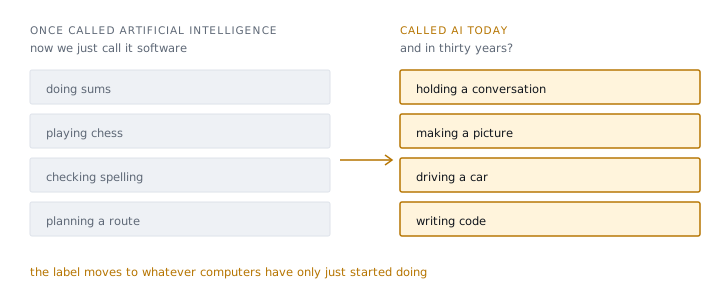
Artificial intelligence (AI) is not the name of one technology. It is a label attached to whatever computers have only just learned to do. Once a task works reliably and everyone is used to it, the label falls off and the task is called software instead.
The figure shows the pattern. Doing sums, playing chess, checking spelling and planning a route were all once called AI. Holding a conversation, making a picture, driving a car and writing code are called AI today. The items on the right are not a different kind of thing from the items on the left; they are simply newer.
This has a practical consequence. When a product is described as “using AI”, the phrase tells you that the feature is new. It does not tell you what the feature does.
Try it
- Route planning on a map app was once called artificial intelligence. Most people now call it software. Using the definition above, explain what changed.
- A spelling checker and a chatbot are both computer programs. Why is only one of them usually called AI?
Answers
1. The technology did not stop working; it started working reliably and became familiar. Once that happened, the AI label fell off and people called it software.
2. Because the chatbot is newer. The label goes to whatever computers have only just learned to do, and spelling checkers have been ordinary for a long time.
Narrow AI and general AI
Grade 7 showed how a computer follows instructions exactly, and then showed tasks that nobody can write instructions for, such as telling a cat from a dog or deciding whether a message is unkind. The systems in this course are built for tasks like those. Each system, however, is built for one task only.
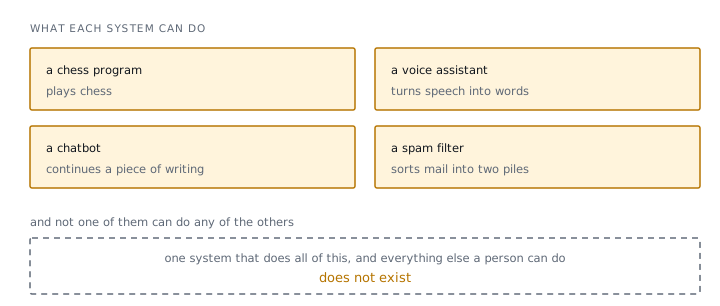
The figure shows four real systems. A chess program plays chess. A voice assistant turns speech into words. A chatbot continues a piece of writing. A spam filter sorts mail into two piles. None of them can do any of the others. A chess program that can beat anyone alive cannot play checkers, cannot tell you the time, and has no idea that it is playing a game.
Narrow AI is a system built for one kind of job that is useless outside it. Every AI system that exists today is narrow.
General AI is the idea of one system that can turn its hand to anything, the way a person can. It does not exist. The empty box at the bottom of the figure stands for it.
Films often show a computer that chats, drives, makes plans and falls in love. That is general AI, the empty box, and no real system is like it. The best systems available today are all narrow.
Narrow does not mean weak. A narrow system can be better than every human on earth at its one job. It just cannot step outside that job. “Narrow” describes the range of tasks a system can do, not how well it does its one task.
Try it
- A spam filter sorts millions of messages a day more accurately than any person could. Is it narrow AI? Explain.
- A friend says that a self-driving car must be general AI because driving is so complicated. What is wrong with this reasoning?
Answers
1. Yes. It does one job, sorting mail into two piles, and cannot do anything else. Being very good at that job does not make it general.
2. Narrow describes the range of jobs, not the difficulty of the job. A system that only drives, however complicated driving is, is still built for one kind of job and is useless outside it.
Correct output and understanding
The second word in the name, “intelligence”, needs care. A calculator gets long division right every time. It does not understand division. It does not know what a number is, or that anybody is waiting for the answer. It produces correct output and understands nothing, and everyone is comfortable with that.
Now consider a chatbot that writes a decent paragraph about the water cycle. There are two possibilities. It may understand the water cycle, or it may be doing something closer to what the calculator does: producing the right-looking output with nothing going on behind it.
People who build these systems genuinely argue about which possibility is true, and this lesson does not settle it. One thing, however, can be stated with confidence: from the outside, you cannot tell the difference. You see the input and the output. Whether there is understanding in between is not visible, and a good answer is not proof of one.
Judging a system by how clever its answers sound is like judging a book by how confident the author is.
This matters in practice, and Lesson 4 comes back to it. A system that produces good output without understanding will also produce bad output without noticing, and it will sound exactly as confident either way.
Try it
- A calculator gets long division right every time. What does that example show about the connection between correct output and understanding?
- A chatbot writes an accurate paragraph about volcanoes. Does this prove that it understands volcanoes? Explain.
Answers
1. That correct output is no proof of understanding. The calculator is always right and understands nothing.
2. No. From the outside, only the input and the output are visible. A correct paragraph is consistent with understanding and also consistent with producing right-looking output without any understanding, so it cannot prove either.
The question to ask
Arguing about whether a product counts as AI is rarely useful. A better question is available: what job does it do?
“it predicts which video you will watch next” → now you know something
The second description tells you what the system takes in, what it produces, and therefore how it might be wrong. The first is advertising.
Whenever somebody tells you a product uses AI, the follow-up is three words: to do what? If they cannot answer in one plain sentence, either they do not know or there is less there than suggested.
This lesson has introduced the three ideas the course is built on. The label moves, every real system is narrow, and good output is not evidence of understanding. Lesson 2 applies them to the systems you use every day without noticing.
Try it
- Rewrite the claim “our camera app uses AI” as a sentence that would actually tell a user something.
- Why does knowing what a system takes in and what it produces help you predict how it might be wrong?
Answers
1. Any plain sentence naming the job, for example: “it detects faces in the frame and adjusts the focus to them.”
2. Once you know the job, you know what a failure looks like. A system that detects faces can miss a face or focus on something that is not a face. A vague claim about AI gives you nothing to check.
Summary
- “AI” is not the name of a technology. It is a label attached to whatever computers have only just learned to do, and it falls off once the task becomes ordinary.
- Every AI system that exists today is narrow: built for one kind of job and useless outside it. Narrow does not mean weak.
- General AI, one system that can do anything a person can, does not exist. Films that show it are showing the empty box.
- Correct output is not proof of understanding. A calculator is always right and understands nothing, and from the outside you cannot tell whether a chatbot is any different.
- When a product is said to use AI, ask: to do what? The answer tells you what it takes in, what it produces, and how it might be wrong.
Key terms
- Artificial intelligence (AI) — a label for whatever computers have only just learned to do, not the name of one technology.
- Narrow AI — a system built for one kind of job and useless outside it; the only kind that exists.
- General AI — the idea of one system that can do anything a person can; it does not exist.
- Understanding — something that cannot be seen from the outside; a correct answer is not proof of it.
Check your understanding
5 questions · 70% to pass · retakes encouraged
In the full course the graded quiz comes next and your progress is saved. Get access to continue.
Want the next free lesson by email? We post new free lessons and short tips for guiding your child with AI.
A short note when new free lessons are posted, plus occasional tips. No spam. Unsubscribe any time.That is the whole first lesson. The full AI For Youth: Grade 8 course has 8 lessons, 8 quizzes, and a project. One subscription unlocks every course, kindergarten through grade 12, plus AI Fundamentals for general audiences.
Get access