
This is Lesson 1 of 8 from AI For Youth: Kindergarten, shown exactly as subscribers see it. No account is needed to read it. Subscribers get every lesson, the graded quizzes, the project, progress tracking, and a certificate of completion.
Get accessYour child already lives in a world full of AI, and that will be true for the rest of their life. The good news is that understanding it is well within reach. This course explains how AI really works at your child’s grade level, one clear lesson at a time, so they can use it with confidence and know when to double-check it. The first lesson is below. Read it together and see if it fits.
This lesson is about counting. To count a row of buttons, you touch each button and say one number. You go slowly, so that no button is missed.
For parents/guardians
- You need: seven buttons, bricks or coins, in a row on the table.
- How long: ten minutes reading, then as long as they want to keep counting things.
- Listen for: their finger moving faster than their voice. That is prompt 3, and it is the most common counting mistake there is.
- Do not correct the number. Let them count again slowly and find it themselves.
By the end of this lesson you can
- Touch each button and say one number.
- Say what goes wrong when your finger goes too fast.
- Count seven buttons slowly, with no button missed.
Counting a row of buttons
Counting is touching each thing and saying a number. One touch, one number.
Look at the picture. There are buttons in a row.
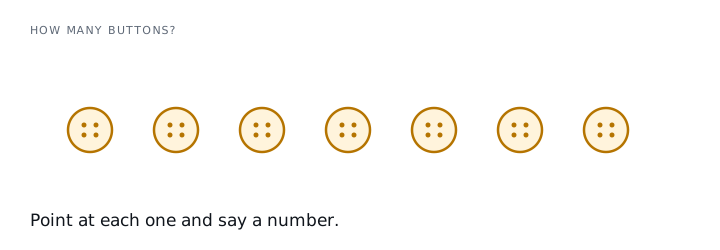
Point at the first button. Say one.
Point at the next button. Say two.
Keep going to the end of the row. Point at each one.
One touch, one number
Every button gets one number of its own. Not two numbers. Not no number. One.
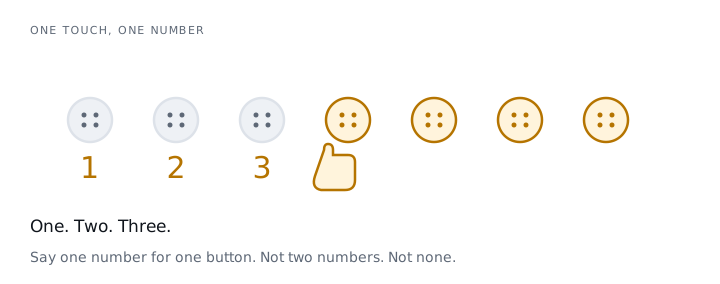
Look at the picture. Three buttons are done. They are one, two, three. The hand is on the next button. That button is four.
Here is how to count one button.
- Touch the button.
- Say the number.
- Move your finger to the next button.
Touch, say, move. Then do it again for the next button.
When your finger goes too fast
Sometimes your finger goes faster than your voice. Then some buttons get no number at all.
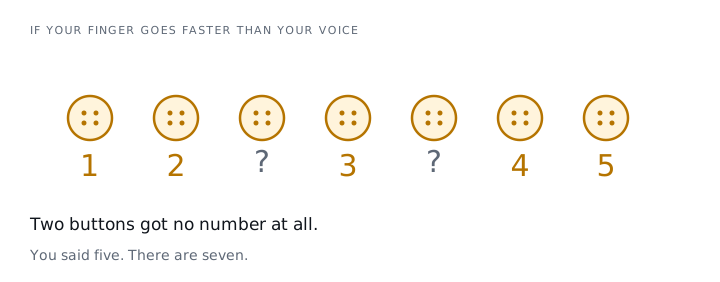
Look at the picture. The child said five. But there are seven buttons. Two buttons have a question mark. They got no number. They were missed.
This happens to everybody. It is the most common counting mistake. The hand runs ahead of the voice.
Counting slowly
The way to fix it is to go slowly. Touch, say, move. Keep your finger on the button until the number is out.
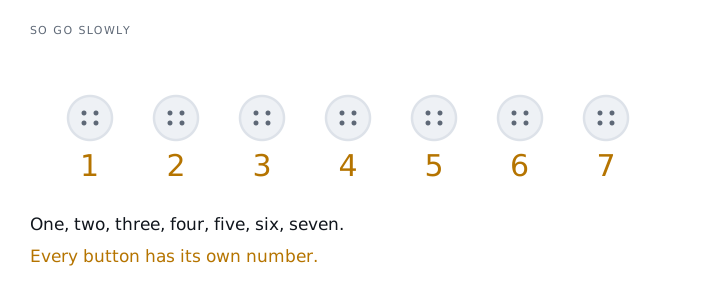
Look at the picture. One, two, three, four, five, six, seven. Every button has its own number. No button is missed. There are seven buttons.
Go slowly. Touch, say the number, then move on. Then nobody gets missed.
Try it
- Put seven buttons in a row. Touch each one and say a number.
- Now count the spoons on the table. Touch each spoon. Say one number for each spoon.
- Ask your grown-up to count the spoons too fast on purpose. Point to the spoons that got no number.
Answers
1. The last number should be seven. Watch that the finger and the voice move together, one touch for one number.
2. There is no fixed answer; the count is right when every spoon was touched once and got one number. If the finger stays on each spoon until the number is said, the count is right.
3. The child should point to the spoons the finger skipped. A fast count gives a number that is too small, because the skipped spoons got no number.
Lesson 2 shows which of the numbers you said is the answer.
Summary
- Counting is touching each thing and saying a number.
- Every button gets one number of its own: touch, say, move.
- If your finger goes faster than your voice, some buttons get no number. In the picture the child said five, and two of the seven buttons were missed.
- Go slowly and nobody gets missed. Seven buttons, seven numbers.
Key terms
- Counting — touching each thing and saying a number.
- One touch, one number — each thing gets exactly one number of its own.
Check your understanding
5 questions · 70% to pass · retakes encouraged
In the full course the graded quiz comes next and your progress is saved. Get access to continue.
Want the next free lesson by email? We post new free lessons and short tips for guiding your child with AI.
A short note when new free lessons are posted, plus occasional tips. No spam. Unsubscribe any time.That is the whole first lesson. The full AI For Youth: Kindergarten course has 8 lessons, 8 quizzes, and a project. One subscription unlocks every course, kindergarten through grade 12, plus AI Fundamentals for general audiences.
Get access